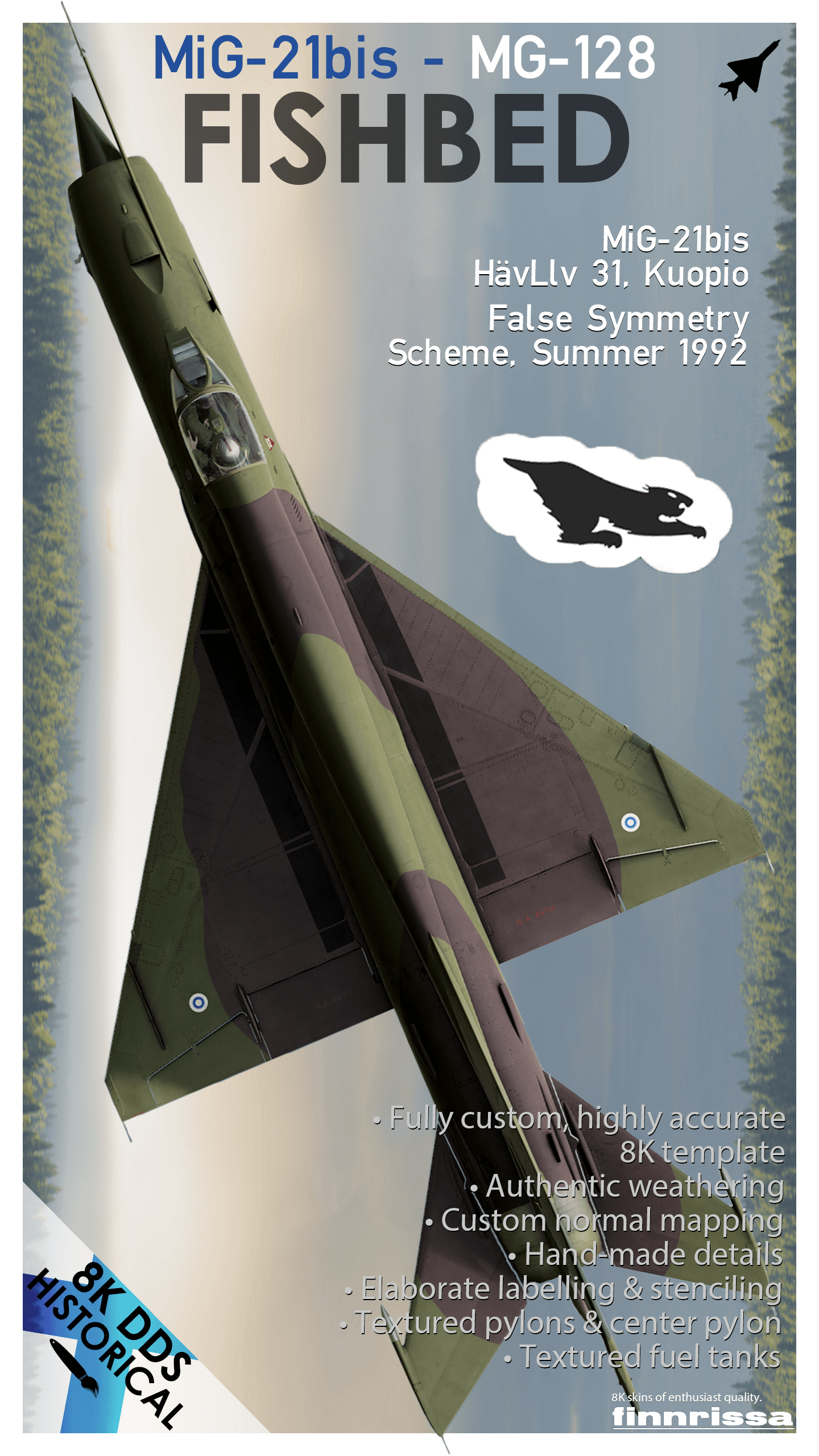
Mikoyan-Gurevich MiG-21bis
Mikoyan-Gurevich MiG-21bis
Hävittäjälentolaivue 31, Kuopio, Finland
'False Symmetry' Scheme, 1992
Tailcode MG-128, S/N 75098124
#mig #mig21 #mig21bis #mig21bisfinland #mig21bis_finland #mikoyangurevich #8k #historical #historicalskin #historicalcamo #finnish #finland #finnishairforce #sweden #fighter #summer_camo_contest
Downloading always produces the latest available version of the skin. This skin is available on the Gaijin marketplace. Thank you all so much for supporting my work! <3
A one-of-a-kind pattern with some unfortunate history behind it...
Cruising at altitude
MG-128 on a test flight at Halli in July 1992. Photo: Jyrki Laukkanen
This fully historical scheme can be traced back to 1992, where a MiG-21bis of the Finnish Air Force, tailcode MG-128, is serving with Fighter Squadron 31, stationed at Kuopio-Rissala Airbase. She joined the MiG fleet in February 1985, likely in the third or fourth batch of ordered MiGs given the delivery date, as it was deceptively numbered MG-127 (all aircraft in the fourth batch were intentionally miscoded on arrival for deception purposes).
Over summer hills
Shallow bank at high altitude.
MG-128 seen here, properly numbered, in early livery. Kuopio, June 1989. Photo: steve ryle via Air-Britain Photographic Images Collection
Past service acceptance, MG-128 served briefly; the airframe received upgrades from 8 August 1985 to 24 February 1986. In 1988, the Finnish government signed into law that all aircraft shall sport lower-visibility schemes: this meant smaller roundels and tailcode (which was moved to the front of the plane.) as you see here. While most MiG-21s in Finnish service received repaints during this period, 128's was postponed as the paint was still in good condition. MG-128 received small markings in fall of 1990.
MG-128 after late livery conversion, still with original paint. Note the quite notable large circle where the old roundel used to be. Photo: Unknown
On the runway threshold.
Flight at low altitude.
Climb.
The plane continued service from that point on. In late 1991, to the summer of 1992, the plane went in for interim repairs & a general overhaul, it was then that the aiframe was repainted into a domestic Finnish scheme. Scheme-wise, it was unique as it was almost symmetrical; definitely painted with symmetry in mind. The scheme ever so slightly differs, but from afar and to an untrained eye, the pattern appears symmetrical. Another notable difference that MG-128's new paint scheme held was the lack of brown paint on the nose compared to its sister airframes, in fact, no other MiG had a clean nose.
MG-128 wearing her new scheme in 1992. Photo: Jyrki Laukkanen
Above thunderclouds
Underside view
Landing
MG-128 continued to fly for what looked like a straightly-paved road ahead of service life, but disaster struck in the grey dark of November of that year when the pilot had lost spatial orientation whilst flying over Tammisaari (now named Ekenäs), south of Tampere and Satakunta where Fighter Squadron 21 operated, where the airplane took off. The airframe crashed into a field whilst flying low in poor weather. The sky was completely overcast, and the pilot did not survive. A memorial near the crash site was erected in his honor.
MG-128 on the cover of Suomen Ilmavoimien Lentokoneet (Finnish Air Force Airplanes) 1918-1993.
Reading the story of MG-128's fate reminded me of how far aviation safety has come even since the '90s, and that not all of it is as glamorous as we can often make it out to be. Additionally, many mishaps were unfortunately way more common due to the heightened alertness of those times, as well as technological limits. Following this crash, a Draken crashed in Jyväskylä 3 days later. It must have been very hard to close out that year.
Hangar collage. As always, unedited.
During her short service life with the Finnish Air Force, MG-128 accumulated 841 hours and 56 minutes of flight time. Even while this was not the only incident the MiG-21 had in Finland, the story of this plane is a careful reminder of how dangerous things can get in adverse conditions.
Ground ops
Livery-wise, I always thought MG-128 was interesting amongst all the MiGs. It is just unfortunate of how history decided to tell its tale. The paint in photos looks much more matte than the not-so-standard paint schemes the Finnish MiG-21s had when they were painted in the Soviet Union. Even with this, the domestic repaints were not so standardized either. I like to give the late MiGs a cleaner look given they were only in service for >10 years after their respective repaints. No other MiG had a roughly symmetrical paint scheme like MG-128 had. Whilst serialized and numbered, each airframe is special and has its own quirks. Being able to represent that in my work has always been a huge motivation of mine.
Backlit with burner lit
MG-128 comes standard with a fully reworked 8K template with a high emphasis on accuracy using multiple MiGs as reference. Same degree applies for the details and weathering. Fuel tanks, pylons are textured as well. Assisting me with the task is former fighter & test pilot Jyrki Laukkanen's book MiG-21 Suomen Ilmavoimissa. It has been a spectacular resource whilst making these skins.
Ground close-ups
Shock cone details
Any issues with the camo? Suggestions, comments, questions? Feel free to write it down below. I read those!
Cover art with no decals.
As always, I want to thank you for both checking this post out as well as your support. Any and all of it keeps me going, I love making stuff and seeing where it gets to go throughout this community. So thank you!
With that, I will see you soonish on the next upload. Take care!
-finnrissa <3