#wirraway #historical #cockpit #remastered #cockpitedit #cockpitview #dds #dds8k #raaf #england
#wirraway #historical #cockpit #remastered #cockpitedit #cockpitview #dds #dds8k #raaf #england
Wirraway means "challenger"
In the language of the Wurundjeri, a tribe of the aboriginal people of Australia, the word Wirraway means "to challenge" or "the challenger". In the search for a suitable name to describe the first independent Australian aircraft construction, this combative-looking term was chosen.
Although the name was original (and originally) Australian, the CA-9 Wirraway itself was developed as a licensed production of the NA-16 by North American Aviation, which was subsequently modified to meet the needs of Australian users.
These modifications mainly included the transformation from an advanced trainer to a combat aircraft suitable for warfare: two 7.7mm machine guns firing through the propeller arc, supplemented by a similar armament of the rear gunner on the back seat, were to make the Wirraway a fighter in the scenario of a conflict with Japan threatening since the second half of the 1930s, and the company also built a device for carrying dropping weapons under the wings of a light bomber.
For the engine the license production was also chosen: the replica of a Pratt& Withney R-1340 "Wasp" radial engine equipped the CA-9 with 600 HP and a top speed of a good 350 km/h.
In July 1939 the "Commonwealth Aircraft Corporation" (CAC) was able to deliver the first Wirraways. Production took place in a newly built factory at Fishermen's Bend in Melbourne. At about the same time as the outbreak of war in Europe in September 1939, the first units equipped with the new design were ready for operation.
Indeed, RAAF Wirraway squadrons were involved in combat operations from the first days after 7 December 1941. However, the CA-9 did not appear as a fighter: a largely missing early warning system and the inferior top speed of the Wirraway, which was underpowered as a fighter aircraft, saved the crews from hopeless interception missions against the dreaded A6M "Zero".
Wirraways were actively involved in the early battles over Rabaul in New Britain, over New Guinea and in the defence against the air raids on Darwin. Surprisingly for all those involved, a Wirrwaway over Gona-Buna, New Guinea in February 1942 succeeded in shooting down a "Zero". However, this was to remain a one-time occurrence.
After CAC had derived an operational fighter plane from the basic design of the CA-9 with the Boomerang, the Wirraway was used in roles which it could better fulfil with its layout and technical capabilities: until the end of the war it contributed to Australia's war efforts as a light bomber, in sea surveillance and as a submarine fighter, but above all as a trainer.
Even after the end of the war, 755 CA-9 Wirraway aircraft were built and delivered, for years afterwards it was still used for flight training and as a communication aircraft, the last aircraft were not taken out of service until 1959. Together with the Boomerang, the Wirraway remained a well-known symbol of Australia's resistance during the Second World War.
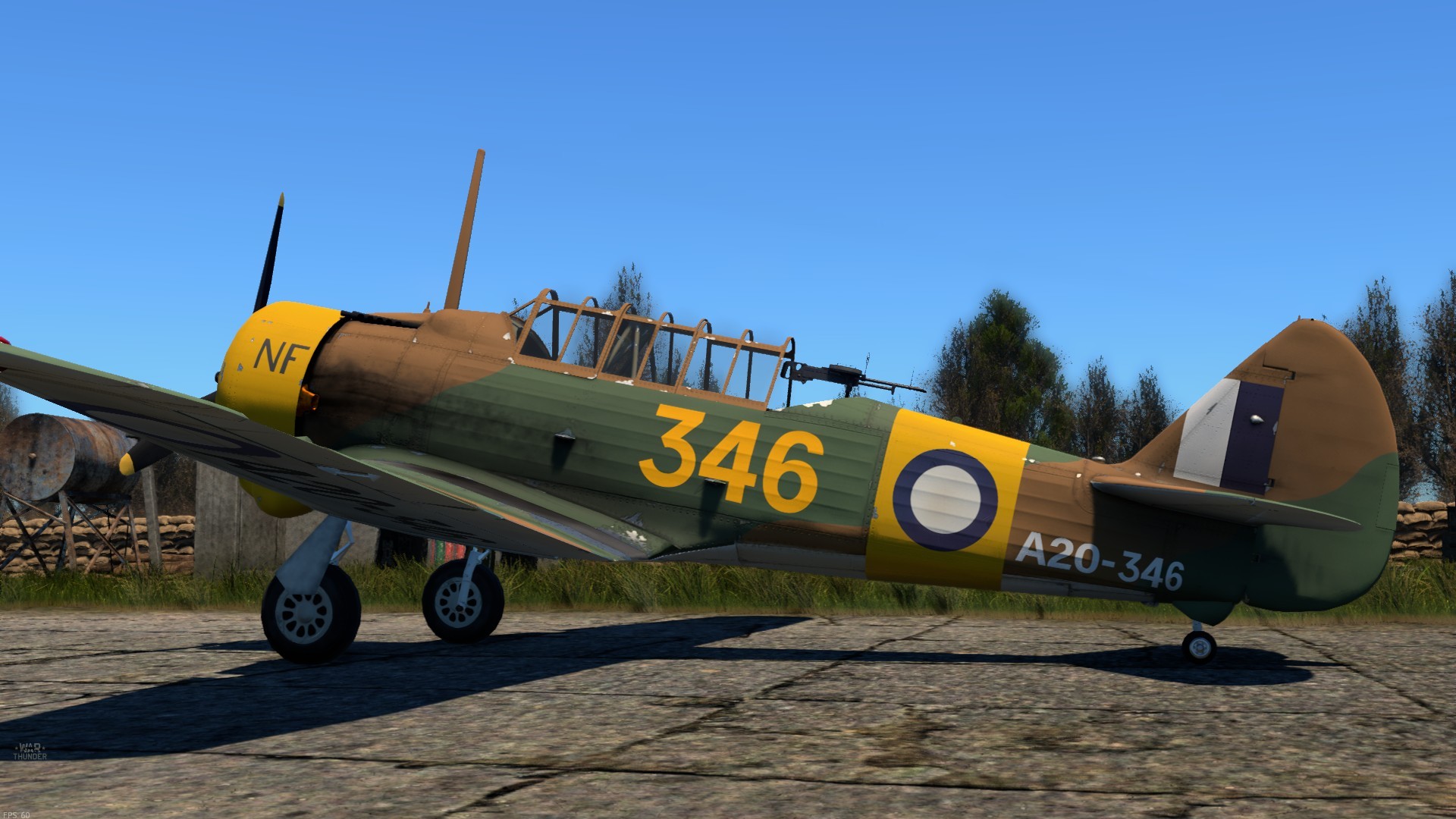
My model shows a CA-9 Wirraway used by the No. 7 Service Flying Training School. This training unit, based in Deniliquin, New South Wales, familiarised future pilots with the advanced skills of military flying. These training units, spread throughout Australia, were part of the literally globally organised "Empire Training Scheme" of Great Britain, one of the foundations of Allied victory.
The construction of this well-equipped multi-media kit, as usual by Special Hobby, brings few surprises, if one is prepared for the sometimes somewhat demanding conditions of a "short run" kit: You will look for locating pins in vain, the sprues of the parts on the injection moulded frames have an impressive thickness, the parts are not numbered and make an impression by a certain clumsiness throughout, which sometimes should be softened a bit with sandpaper.