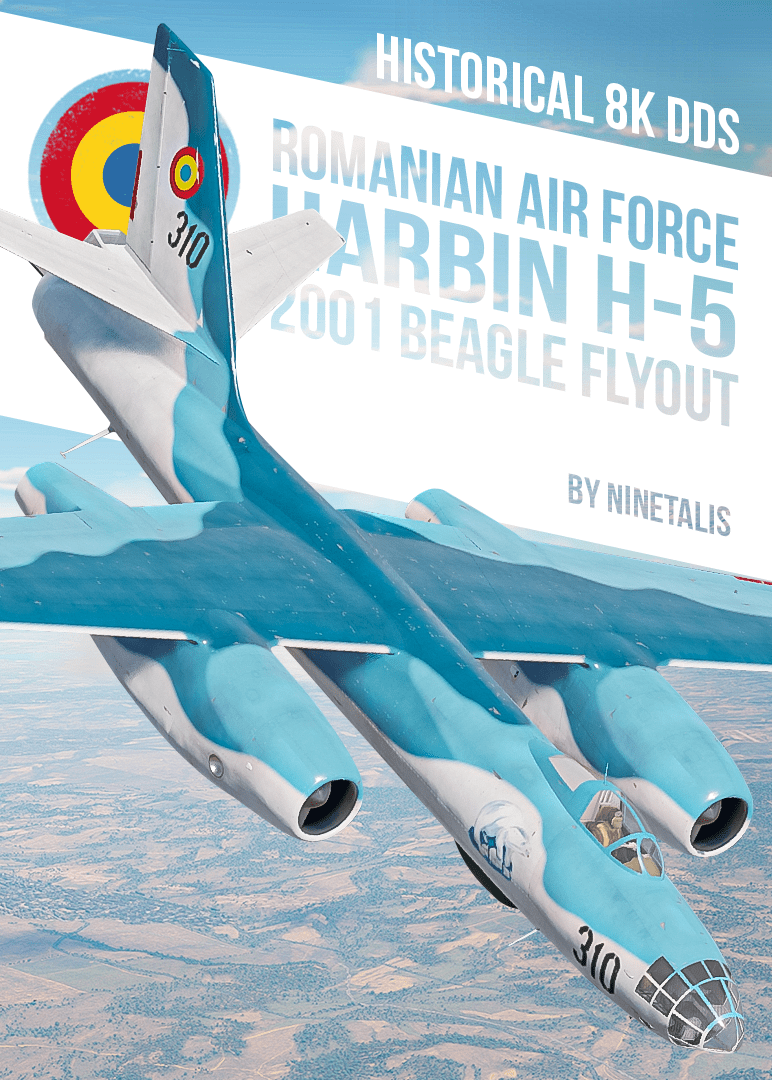
Harbin H-5, c/n 511710310, 310, Escadrille 38 Aviație Cercetare, Borcea-Festesi, Early July 2001.
Harbin H-5, c/n 511710310, 310, Escadrille 38 Aviație Cercetare, Borcea-Festesi, Early July 2001.
Great news! It's time for a Romanian Special! Although it's not a Dacia Sandero, the new Hungarian subtree had me dust off my IL-28 template to put to use. While currently I cannot find any actual evidence of any noteworthy Hungarian Beagle paint schemes, I did remember this special paint scheme I started ages ago. As such this seemed to be a good reason to wrap up this one up. Enjoy this unique Beagle to grind out the new subtree, and who knows, potentially a few more good boys coming up?
The aircraft
Listed as c/n 511710310, 310 in short, this Harbin B-5 was delivered on the 19th of January 1972 to the Romanian Air Force. This means this aircraft was part of the additional order that Romania had placed of Chinese copies for there already in service Soviet IL-28’s and IL-28U’s. (More about that can be found in the next segment). Like most Romanian Beagles, 310 lead a mostly unremarkable service life with the Romanian Air Force.
But by 2001, the Romanian Beagles had all run out of their airworthiness, with 310 being one of the last (if not THE last) flying aircraft of the type with the RoAF. As such, it was planned that the aircraft would make an appearance at RIAT 2001, and was therefore painted in this rather unique paint scheme, which is probably the most unique paint scheme any IL-28 ever received. Sadly however, the day before it was meant to leave from Romania for RIAT 2001 at Cottesmore in the UK, the aircraft crashed during landing at Borcea-Festesi after a routine training flight.
After taking off from the same airbase and completing its flight without incident, the pilot attempted to land at its home base in very bad weather. As it was making its final approach and touchdown, a strong crosswind unbalanced the aircraft. As the pilot deployed the braking chute, the plane veered off the runway during which the right wing and engine nacelle separated from the airframe. Its crew, Lt. Cdr. Ion Babusanu (pilot), Lt. Cdr. Vasile Coman (navigator) and Plt. Adj. Toma Nelu (radio operator and gunner), from the 38th Reconnaisance Sqn. Fetesti, were luckily unharmed.
This sadly meant that the aircraft never made it to RIAT to be displayed in these colors, causing this unique paint scheme to remain quite unknown. Additionally, at that moment there were no other airworthy airframes of the type with the Air Force at the time, and thus the whole visit of the Romanian IL-28 at RIAT in 2001 had to be cancelled. Instead, BT-5 408 was on static display at the Romanian International Air Show at Mihail Kogălniceanu airbase within the country’s own borders.
With the type already being planned for retirement within the force, no effort was made to repair the aircraft. So although the aircraft did not catch fire or any other type mayor damage during the ordeal, it was written off and remained stored outside, slowly picked apart over the years. Where the aircraft is now is a bit of a mystery for me, but I assume that whatever remained has since been scrapped.
The Beagle with the Romanian Air Force
Ironically, the IL-28 story with the then ‘Forțele Aeriene ale Republicii Socialiste Română’ ( Air Force of the Romanian Socialist Republic), was one very different from our subject. It was in fact the first type of aircraft intercepted by the newly established Aerial Force, when a soviet IL-28 entered the Romanian Airspace without authorization In 1952.
Nonetheless, by 1954 the government decided to order several of the type for itself from the Soviet Union, which were soon delivered and introduced by March 1955 with the Regimentul 282 Aviație Bombardment (282nd Bomber Regiment) based at Lanca. Ironically, the aircraft were delivered in Soviet markings instead of Romanian ones, which were quickly applied by crews on sight. At this time of this initial order, 14 Soviet-built IL-28’s would be delivered. Due to the naming conventions used by the Romanians, the exact number of types used aren’t exactly clear, but it consisted of a variation of bomber and trainer types.
Despite this unknown numbers, we do know the Romanians immediately decided to take the overhauling and repairs upon themselves. This is one of the reason why the roles the Romanian beagles would fulfill over the years would turn out to be extremely varied. From obvious tasks like bombing and recon, to bomber crew training, target towing, practice targets, nocturnal missions, air defense radar operation confirmation, and even Western ‘propaganda radio signal’ blocking (basically meaning blocking radio news broadcasting from Western Europe), for which 2 aircraft were outfitted with Romanian installed ECM equipment. However, it was noted that the latter efforts were not particularly effective.
Similarly, during the Hungarian uprising which occurred in October 1956, the 282 Regiment was placed on high alert, and would fly several reconnaissance missions within the nation. Another noteworthy event occurred on the 19th of April, 1958, when a Romanian IL-28 performed a mission to film the total eclipse of the sun. Sadly, by 1960, the regiment was demoted to a squadron, as not enough aircraft were available to outfit an entire regiment. During this time, 433 and 443 were modified for target towing duties over the Cap Midia gunnery range, while others would continue completing various other duties. By 1972 however, most of the remaining Soviet-delivered IL-28’s had reached their safe flight hours usage limit.
Because of this, an additional order was placed for more Beagles. These would not come from the Soviet Union, but from China in the shape of 14 Harbin H-5’s (which some sources refer to as B-5’s), 12 of which were bomber variants, with the remaining two as BT-5 trainer variants. One of these, 307, was converted for target-towing duties. This meant the squadron was renumbered as Escadrille 38 Aviație Cercetare. Like the Soviet machines, the Romanians decided to continue their own overhaul program, and upon the H-5’s first overhauls, these aircraft were repainted from natural metal to overall light grey (aside from the white rear turret). Soon after in 1984, the old pentastar insignia was repainted with the then newly introduced red/yellow/blue roundel.
Sadly, not as much has been known about the service life of this second batch of Chinese aircraft. But there is. one story of note, being how the aircraft ended up being retired. By the turn of the decade, it was clear the aircraft had seen better days, with all but a handful already having reached their safe usage limit after 30 years of service.
As a last hurrah, the last operating European Beagle operator (as North Korea was the only operator of the top at the time), intended to make an appearance at RIAT with an IL-28 painted in a special paint scheme for the event. But in a cruel twist of fate it was not meant to be as the specially painted, and only airworthy Romanian Beagle at the time, crashed upon landing after a routine training flight. While the crew escaped unharmed, the starboard wing had been ripped off and the aircraft was written off. With no alternative airframe available in time for the event, the Romanian Beagle appearance at RIAT had to be cancelled. Instead the type made its last public farewell at the Romanian International Air Show (RoIAS 2001) at Mihail Kogălniceanu airbase, with BT-5 408 displayed statically, and with it, the end of the 38th Sqn who operated the type.
To end on a positive note, the Romanian Air Force ended up being one of the longest operators of the type, andover time, the Beagle had proven its worth and popularity with its Romanian crews. An example of proof for this is how the crews referred to their machines; Blândul Ben, ‘Gentle Ben’, a name originating from a gentle bear in a Romanian television series with various movie spinoffs.
#Ilyushin #IL28 #harbin #h5 #harbinh5 #bomber #romania #romanian #romanianairforce #hungary #8kdds #8k #dds #historical #historicalcamo