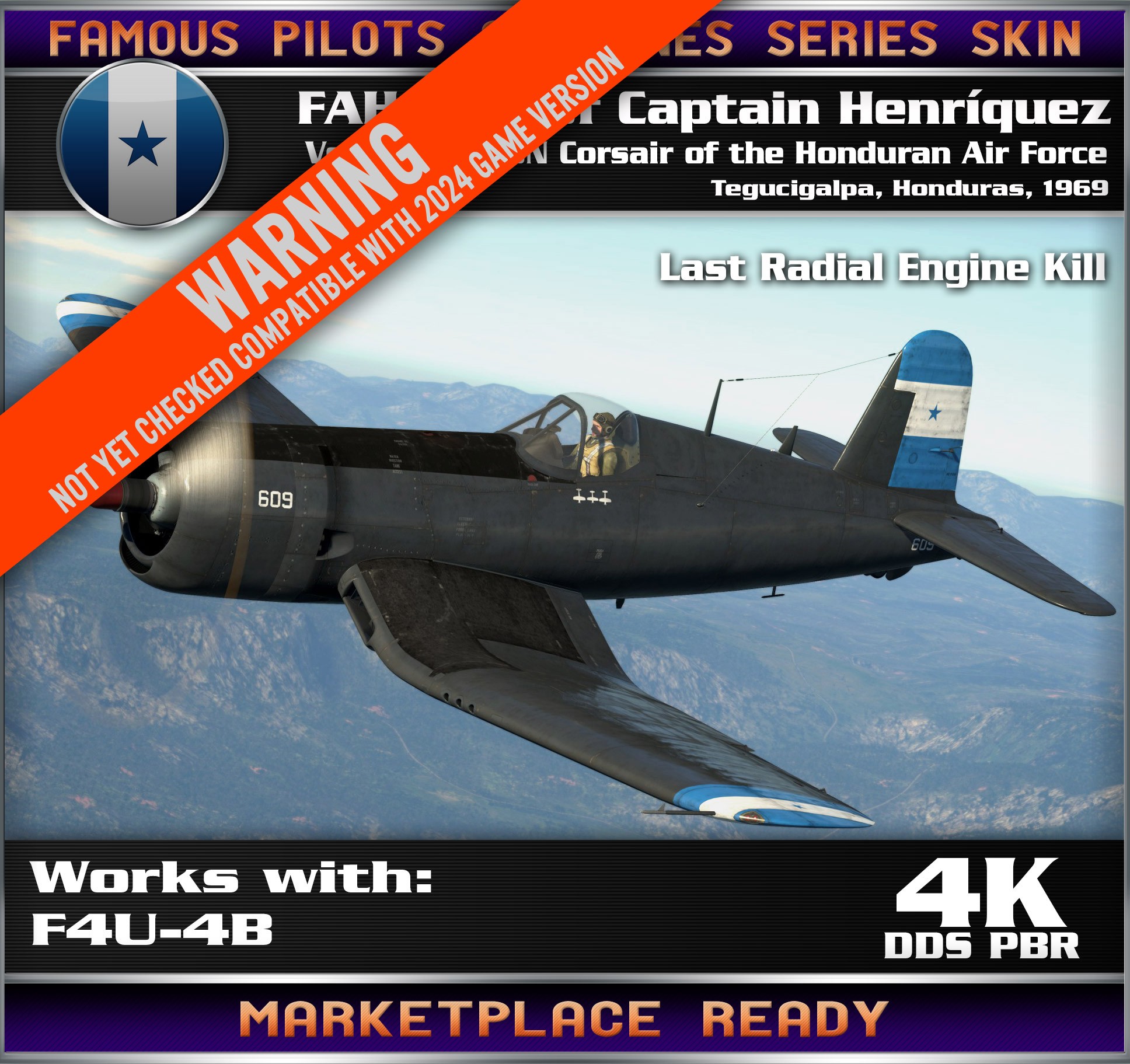
Skin # 178: Honduran Corsair
Skin # 178: Honduran Corsair
#aotea #famous #market #marketplace #Honduras #Honduran #Historical #F4U #f4u4b #Corsair #soccerwar
This is a special request for a re-release of my original Honduran Corsair skin now for the F4U-4B for @XATRUCH_HND .
The last dogfights between piston-engine, propeller-driven airplanes weren’t fought in the skies over Germany in the 1940s or even Korea in the 1950s. They occurred in Central America in 1969, and all of the combatants were flying U.S.-built Corsairs and Mustangs.
The dogfights were among the final acts in a brief but bloody four-day conflict between Honduras and El Salvador, commonly (but misleadingly) known as the Soccer War. Although a pair of football matches between the two nations sparked the initial riots, the war was the culmination of longstanding tension over immigration and land reform.
Although two kills short of “ace” status, Honduran Air Force pilot Captain Fernando "El Flaco" Soto Henríquez became a national hero when he downed three Salvadoran fighters (the only aerial victories ever recorded by a Central American air force) in Vought F4U-5N Corsair BuNo. 124715. This was the last occasion on which piston-engined fighters fought each other. This aircraft FAH-609 was the last piston fighter to record a kill.
While strafing ground targets near the Honduras-El Salvador border, on his second mission of the day, Captain Soto got a call that one of his fellow pilots, Captain Francisco Zepeda Andino, had jammed guns and two Salvadoran Cavalier F-51 Mustangs on his tail. Captain Henríquez entered the fray quickly and let loose a burst of 20-mm gunfire. The Mustangs broke…one left and one right. He turned starboard inside one Mustang, fired three bursts. His target caught fire and augured into the ground. The pilot, Captain Douglas Vladimir Varela was killed after his parachute failed to deploy. The other Mustang bugged out.
Later, on his third mission of the day, Captain Henríquez downed two Goodyear FG-1D Corsairs, the first one after a short burst, and the pilot, Captain Salvador Ceceña Amaya, was able to parachute to safety. The second Corsair was taken in a hard fought, turning and diving dogfight, from 12,000 feet to about 9,000 feet. It exploded and the pilot, Captain Guillermo Reynaldo Cortéz (considered to be the best Salvadoran fighter pilot) was killed instantly.
These three kills are the only recorded instances of two American aircraft dogfighting each other.
This action was the last air-to-air engagement between Honduras and El Salvador, and Henríquez ended the war with the only three recorded aerial kills. He went on to become director of civil aeronautics and was declared a national hero by the National Congress of Honduras in 2003. He died three years later on June 25, 2006, at age 67.
The Hondurans continued to fly Corsairs for a decade after the Football War. Henríquez’s airplane, FAH-609, was transferred by legislative decree to the Air Museum of Honduras. Although FAH-609 last flew in 1981, its fuselage still carries the white silhouettes of three airplanes—two Corsairs and one Mustang, the kill markings graphically symbolizing the end of the era of propeller-driven dogfights.
A couple of notes on this camo scheme: I have found multiple photos of 609, some with the Honduran flag on the rudder with a straight edge, and some with a stepped edge. I chose to make my camo with the stepped edge
Although I can't find any written record of a coloured prop hub, and every drawing/model I've seen of this aircraft shows either a black or silver hub, I did dig up a single grainy colour photo that appears to show the prop hub painted the same red as the fire-extinguisher. It's faint and in shadow, but if you look it's clearly red. So that's how I've gone in this camo.