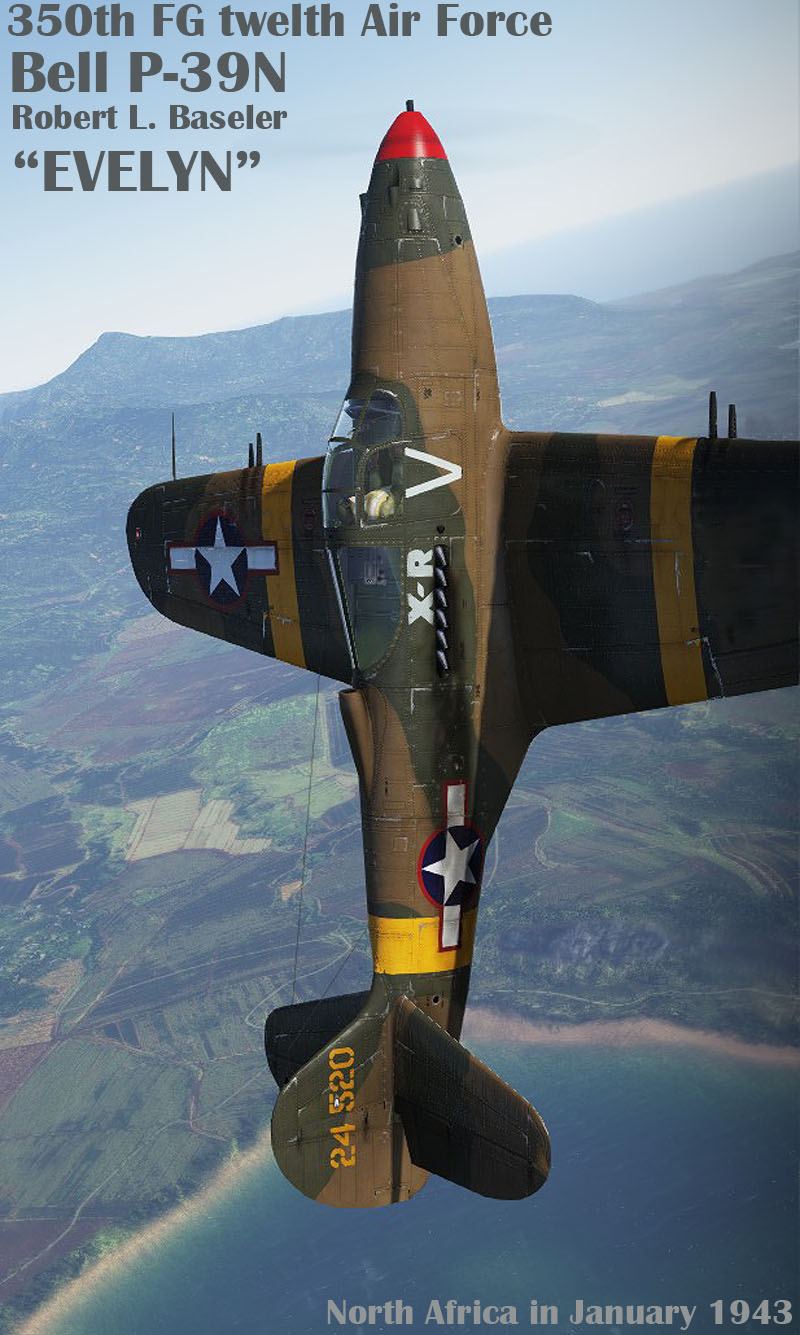
Bell P-39N Airacobra
Bell P-39N Airacobra
350th FG Twelth Air Force North Africa
Previously served with 81st FG as "X-R"
pilot Robert L. Baseler
First a little of history.
The decision to invade North Africa in November 1942 was not made until the middle of August, 1942. Forces available for this difficult operation were minimal—it becoming necessary for the USAAF Eighth Air Force to withdraw most of the combat groups that had reached England by that time from an embryonic bombing campaign over Europe to take part in the battle for control of Northwest Africa.
Export versions of the P-39 originally ordered for the French Air Force in early 1940 had, after the fall of France in May 1940, been sent in several shipments to the RAF beginning in early 1941 to augment the RAF’s fighter force after the Battle of Britain. However, after Hitler turned his attention to the East, the pressure was off the RAF and it had fielded only one P-39 unit (601Sq) in 1941. The other P-39s remained in storage in the crates in which they had arrived. At the same time, by the summer of 1942 the number of American pilot volunteers in the RAF serving in England had grown to a few hundred in number. In urgent need of additional fighters to support the forthcoming invasion, American planners decided to combine these two assets already in England and at the end of September 1942 the American pilots in the RAF were invited to transfer to the USAAF. On 1 October, a number of pilots from the USAAF 31st and 52nd Fighter Groups, who had flown P-39s in the US prior to there arrival in England in June of 42, were ordered to report to RAF Station Duxford England to help activate a new Group, designated as the 350th Fighter Group with three subordinate Squadrons, the 345th, 346th and 347th . (The American Eagle Squadrons were re-designated the 4th Fighter Group about this time but the 350th was the only Group activated from scratch in Europe, in WW II). At the same time, some of the American pilots who had just transferred from the RAF were ordered to the new Group to make up the other half of the original aircrew roster.
When I decided to make this skin, a lot of problems has occurred. I discovered that there are many myths about paint schemes of cobras in North Africa.
What is the true?
350 FG's squadrons were equipped with P-39s from RAF stores in the UK. These would most likely have been in a pseudo-RAF green + brown over neutral grey color scheme initially. I ran across some profiles that show 350 FG P-39s in sand + brown schemes. I doubted this at first, because the shapes of the colors don't look much like RAF patterns. Still it could be that the green segment of the camouflage was over-painted sand in North Africa (never confirmed)
From Squadron Air Force Colours 1942-1945 Volume 2:"The 81st FG's P-39M's are prepared for a morning flight in England. Camouflage is RAF Dark Earth and Dark Green with Sky undersides and spinner, applied at the US factory. Unit markings were nor used until after the 81st moved to North Africa in January 1943."
All these P-39s have factory finish as requested by the British Purchasing Commision, ie. Dark Earth-Dark Green-Sky ( or "Sky Type S Grey" in the US ) but with slight differences between aircraft---if rubber masking mats weren't used this was the result. The very light spinners are also Sky.This RAF camouflage scheme can be identified by the light colour undersides brought up to the tailplane; this was the colour scheme specified when they were first ordered, by the time the first Airacobra Is (Model 14s) arrived in the UK it had changed to Dark Green-Ocean Grey ( "Mixed Grey" at first ) and Medium Sea Grey, and they were re-painted accordingly---with a straight colour division between top and bottom. These colours were retained by the Soviets when the Airacobra Is were sent there in 1942. Other P-39 models from the US were standard Olive Drab-Neutral Gray, in most cases left thus (as were the later P-63s).P-400s shipped to the S. Pacific also had the early RAF colours but in this case many still had RAF serials.The original Bell factory finish featured a very high colour division following the nose panel lines and stepped up on rear fuselage. This was corrected on delivery.The only RAF squadron assigned Airacobras ( No. 601 at Matlaske and Duxford) only flew a few sorties in Oct. 1941 before re-equipping with Spitfire Vs; the Airacobras were stored pending delivery to the Soviet Union in 1942.in cases where British aircraft (or those supplied to the British) WERE re-painted in N. Africa or the MTO ,the Dark Green would have been replaced by Middle Stone, keeping the Dark Earth; in the specified scheme as requested by the RAF and applied at the Bell factory, the area at the top of the vertical tail on the left was always green (the darker colour in photos).
In all these photos I believe the dark green is retained as can be seen, plus the light Sky colour under the tails; after a few weeks in service the colours would fade anyway in this climate and would be toned down.
On the other side, in areas like the Western Desert , the RAF felt green was not appropriate and lighter colours were used. It was also believed that Sky was usually too light and various blues were tried like Mediterranean Blue until Azure Blue was adopted.Also at this time I think the priority would be to get planes operational rather than update the camo ( with the exception of national insignia revisions though these were no doubt hurried----note the off-line bars on "Evelyn").The Sky spinners would have been camouflaged or more likely painted the red theatre colour.Certainly towards the end of the campaign in Tunisia there were P-39s in OD--NG, so Olive drab is the colour of replaced panel. If anybody has more accurate info about repainting of this aircraft, let me know about it
#P39