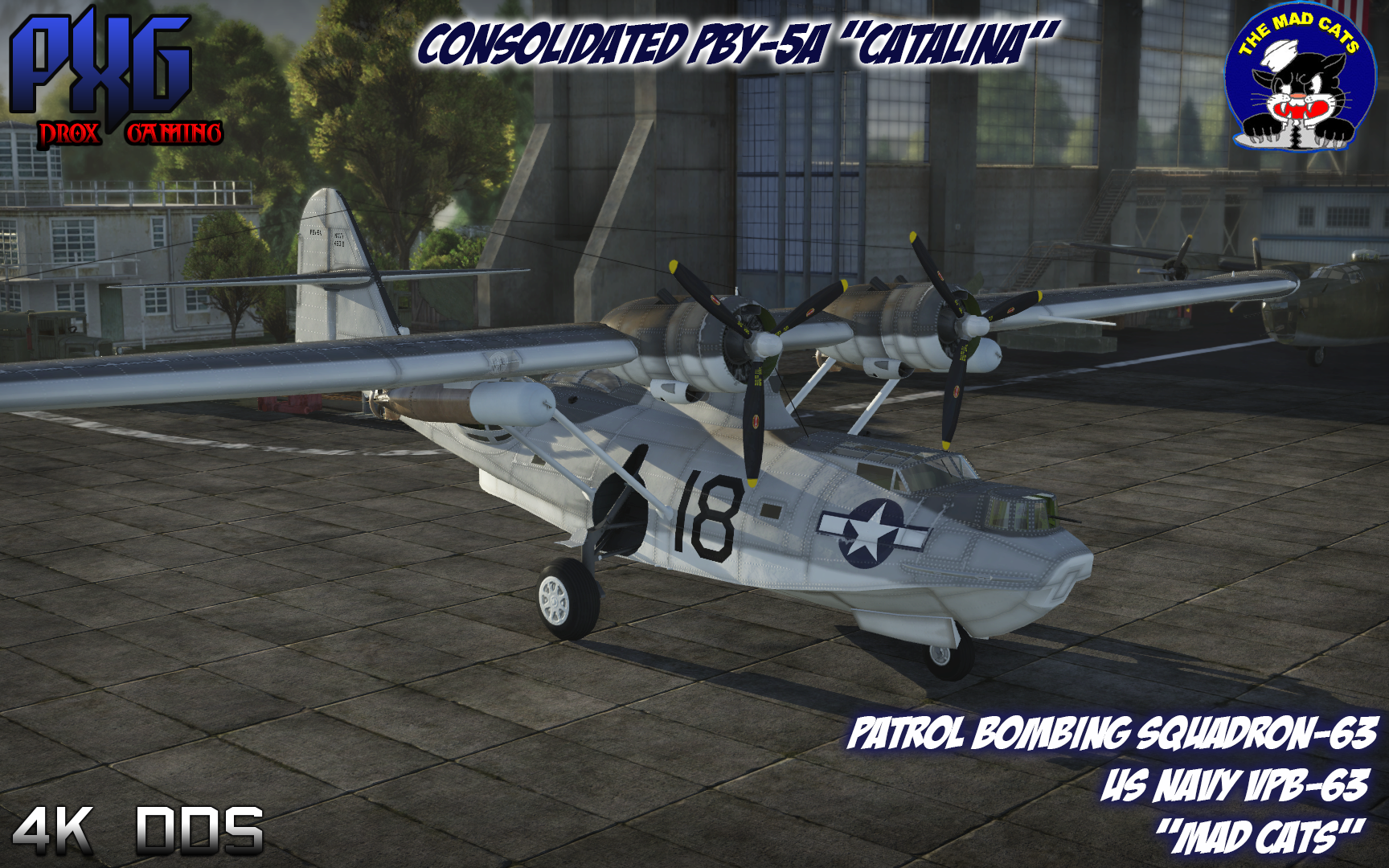
Consolidated PBY-5A Catalina
Consolidated PBY-5A Catalina
BuNo. 48318 / 18 / R
US NAVY
VPB-63 “MAD-Cats”
Port Lyautey, French Morocco
February, 1945
#prox #prox_gaming #pby #catalina
Another "Atlantic" themed skin, this time an U-boat hunting Cat!
The Consolidated PBY Catalina, also called the “Canso”, was one of the most widely used seaplanes of World War II. The Catalina’s served in every branch of the US Armed Forces and in the Navies of many other nations.
During the war, the “Cats” were used in anti-sub warfare, patrol bombing, convoy escorts, search and rescue missions and cargo transport. The “PB” designation stood for “Patrol Bomber” while the “Y” being the code given to Consolidated manufactured aircraft.
The last active military PBY’s were not retired from service until the 1980’s and even today, nearly 80 years after its first flight, the aircraft continues to fly as a water-bomber aerial firefighting operations all over the world.
This skin represents one of these “Canso’s” assigned to VPB-63 Squadron assigned to the Atlantic Region.
Patrol Squadron SIXTY THREE was established on September 19th, 1942 and converted to Patrol Bombing Squadron SIXTY THREE on October 1944.
The squadron was given the nickname “THE MAD CATS” due to their anti-sub hunting equipment. It featured the face of a “Mad” cat wearing a sailor uniform, holding a broken submarine.
The squadron was originally intended to be used in the South Pacific as a Black Cat squadron operating out of Guadalcanal, but shortly after its establishment a decision was made to use it as a test bed for two new technological innovations—Magnetic Anomaly Detection (MAD) equipment and retro-firing rockets.
The MAD gear was designed to detect the presence of a submarine underwater, while the 12 (later 15) retro-firing rockets overcame the tendency of air-dropped depth charges to overshoot the target by canceling out the bomb’s forward trajectory as soon as it was dropped.
A third device was soon added to the squadron’s arsenal, the passive-listening son buoy. This equipment was dropped over the suspected location of a submarine and allowed the aircraft PPC to determine with a high degree of accuracy the target’s depth and position.
After training and testing of the new equipment, VP-63 departed NAS Quonset Point for RAFB Pembroke Dock, South Wales, for operations with the RAF 19 Group Coastal Command and assignment. On July 23rd 1943, VP-63 became the first U.S. patrol squadron to operate from the UK in the campaign against U-boats.
Then in the summer of 1944, eight PBY’s were transferred to Port Lyaute, and were assigned identifying numbers from “16” to “23”. They were also applied the ASW Scheme I, which consisted of Dark Gull Grey upper surfaces, light gull grey sides over a white bottom.
Here, they would establish a two-aircraft barrier patrol system between the southern tip of Spain to the tip of Spanish Morocco. The Catalina’s would fly at an altitude of only 55 feet, flying from dusk til dawn in all types of weather. Many German U-boats would meet their demise at the hands of the “Mad Cats”, which “turned the Mediterranean into an Allied lake”, as Admiral Sir Andrew Cunningham stated. This area would be nicknamed, “The Gibraltar Fence”.
With the war slowing closing and the lack of U-boat presence due to the “Fence”, many PBY’s were detached from the RAF unit and either sent back to the U.S. for re-tasking, or to Devon to continue with the RAF Coastal Command.
In January 1945, four PBY’s from the now VPB-63 transferred to the US Navy Base to Upottery, to continue the MAD sweeps of the English Channel. One was damaged by flak and had to land in France, and a second made a forced landing, also in France due to bad weather.
During one of their routine patrols, this same aircraft, 48318/R (the RAF PBY’s had switched their number identifiers to letters) VPB-63 made its last U-boat attack of the war on April 1945. Lt Frederick G Lake was piloting “R”, and was patrolling off the French coast in the Bay of Biscay, when a periscope was detected off the aircrafts port beam. Diving from 2000ft, Lake fired 24 retro-bombs from 100ft off the MAD signature. One which caused an explosion that brought debris and oil to the surface, thus signaling an end to the short-lived career of U-1107 (commanded by Kapitanleutnant Fritz Parduhn).
All the remaining PBY’s of VPB-63 were finally returned to the U.S. at Norfolk on July 1945, where it was disestablished. 48318 would later be assigned to the Naval Air Reserve Training unit in Dallas, Texas in June 1947, until stricken on August 1948.
Skin created off of @Spogooter 's blank upload as a base, with all panel lines, markings and weathering made from scratch, as well as the modified Normal mapping file(s).
Also included are the extra files for the 5A series from the CDK, all in 2K resolution and DDS formats.
BLK's of all four PBY's have been included.
Textures are in 4K resolution and DDS formats.
Feel free to DL and comment!
~PROx_GAMING
#antisub#atlantic##NAS#1945#USA#USN#Navy#norfolk#proxy#murica#bomber#patrobomber#usnavy#semihistorical#dds#hdd#4kdds#freedom#burgers#gibralter#uboat#mediterranean #pby_5 #pby_5a #mad #morocco #hunter #norfolk #raf #pby5a #englishchannel #patrol #frenchcoast#pby_catalina #matcats #premium