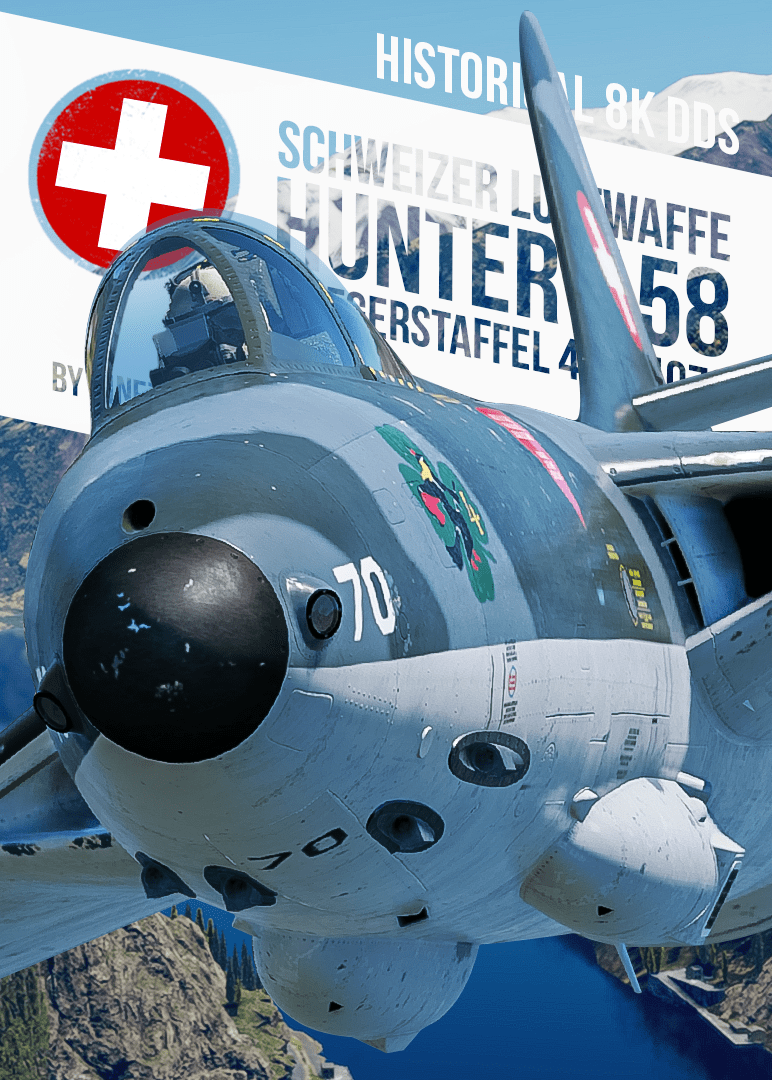
Hawker Hunter F.58 late - c/n 41H-697437 - J-4070 - Fliegerstaffel 4, Swiss Air Force - Emmen, 20 May 1991
Hawker Hunter F.58 late - c/n 41H-697437 - J-4070 - Fliegerstaffel 4, Swiss Air Force - Emmen, 20 May 1991
Who would have expected the reveal of the Swiss air tree in the middle of my Swiss Hunter series? Well the good thing is that now I can accurately re-adjust some uploads to the early model, AND I can upload a mix of early and late skins instead of just one type. So as I had planned for now my second and last FlgSt 4 upload. Next will be, well, something I had not planned to do next but really wanted to create, see you guys soon!
The aircraft
Today on the line we have J-4070. Originally know as XE58 on the Hawker production line, we only know its centre fuselage construction number, 41H-697437. Built and completed at Kingston-upon-Thames plant, the aircraft was a straight from the factory F.58 and first took flight on the Third of September 1959 with pilot Don Lucey at the controls. The aircraft was then delivered about a month later, touching down at Emmen on the Second of October with pilot Hans Häfliger in the cockpit. It would take two weeks, but the aircraft would go on to be delivered to its operational squadron on the 16th.
During its career, the aircraft would go on to serve with both Fliegerstaffel 4 and Fliegerstaffel 5. Other than the usual receival of the SIWA upgrade in 1964 and Hunter 80 program update, which added countermeasures, radar warning avionics and air to ground capabilities (cluster bombs in 1980 and Mavericks in 1982), the aircraft led mostly a relatively unremarkable service life.
Like most Swiss hunters, the aircraft would be retired with over 2500 flight hours, 2654 to be exact, completing a total of 1377 landings by the time it was pulled from service on the 28th of November 1994 at Meiringen Airbase.
But, fate would have it that the aircraft was not scrapped, and as a matter of fact the aircraft still survives to this day. On the 23rd of March 1995, the aircraft was ferry-flown by pilot Rudof Erni to Meiringen-Emmen, which is where the aircraft spent most of its career. It was then put on display on a pole next to what is now the "Patrouille Suisse Fanclub" rest area. The aircraft did recently receive some paintwork (and maybe slight restoration?) in 2022, but has since been put on display again as of writing.
The Hawker Hunter with the Swiss Air Force
With the aviation industry still quickly evolving in the mid-50's, the Swiss Air Force decided it was in need of a new fighter to replace the fleet of DH Vampires in service. Evaluating various aircraft as prospective options, such as the F-86, Folland Gant and even the domestically produced FFA P-16, officials were very keen on the Hawker Hunter. Two aircraft were loaned to the Swiss for extensive evaluations, and by 1958 an order of 100 aircraft was placed. These would be serialed from J-4001 to J-4100.
Based on the then current Hunter F.6, a new variant called the Mk.58 was specifically created for the Swiss. This included different radios and additional pylons on the outer wings. The first twelve would be former RAF Mk.6 aircraft (J-4001 till J-4012, while the remainder would be delivered straight from the factory with deliveries occurring between April 1958 till April 1960. Of these initial orders, the aircraft would go on to serve with Fliegerstaffel 1, 5, 8, 11 and 21. In addition, since 1964 the Swiss aerobatics team, Patrouille Suisse would use the type as their aircraft of choice.
Later additional contracts were placed for more aircraft in 1971 (J-4101 to J-4130, delivered by April 1973), 1973 (J-4131 to J-4152, delivered by February 1975) and 1974 (double-seat trainer variant TMk 68, J-4201 to J-4208, delivered by June 1975). These would all be refurbished aircraft with the necessary adjustments made to bring to their respective variants, and delivered by land.
Although the F-5E emerged by the mid-70's as the next modernization of the air-to-air fighter type for the Swiss, the Hunter would continue service as the primary ground attack fighter. Because of this change in usage, as well as the then recent additional orders, the aircraft would go on to serve with a large number of new units, adding Fliegerstaffel 3, 4, 7, 15, 18, 19, 20 and 24, Zielfliegerstaffel 12, as well as the Escadrille 2, 5 and 6 as units operating Hunters or having the type in their operational line-up.
These additional orders are quite interesting, as various attempts had been made over the years to replace the aircraft. This included types such as the Mirage III, which the Swiss did put in service, but also other aircraft such as the Fiat G.91YS and the A-7G Corsair II, which never bore fruit. Instead Hunters were continually being upgraded, with upgraded such as the Aim-9 (SIWA) upgrade, adjustments for napalm bomb carrying capacities, or the Hunter 80 program which added chaff/flare dispensers, radar warning receivers and an AGM-65B Maverick capability upgrade.
But with the slow march of time continuing, the type would eventually have to retire despite its popularity. By 1990 there were still 9 squadrons operating the type. But with the turn of the decade, a reoccurring pattern of structural wing problem kept rearing its head. The Swiss were eventually forced to retire the type by 1994, and with it its capability of air-to-ground operations. Overall very few Hunters were lost over the years compared to hours logged and years in service. Most of the initial batch had flown nearly 2500 hours, with some going beyond and up to 2800 hours, one nearly reaching 2900 operational flight hours. Most would go on to complete nearly 1500 take-off and landings during their operational life.
Despite the heavy use of the initial batch, later batches that arrived 20 years later naturally had lower numbers, varying around 1200 to 1500 hours each. With these machines being well maintained and documented, many would survive their military life, with some even being flown to this day in acrobatic displays, aggressor training or used for 'jet-tourism'.
#hawker #Hunter #Hawkerhunter #hunterf58 #swiss #Schweiz #suisse #svizzere #swissairforce #8kdds #8k #dds #historical #historicalcamo #swissairtree